

In the manufacturing of metal parts and structures, not everything is about cutting, bending, or welding steel. To obtain specific mechanical properties and ensure the products last, heat treatments in steel are essential. These processes modify the internal structure of the material, improving hardness, strength, and ductility according to the needs of each project. In this article Metal Transformed Toral, we explain the main heat treatments applied to steel: tempering, annealing and quenching, their differences and where they are usually used.
What are heat treatments in steel?
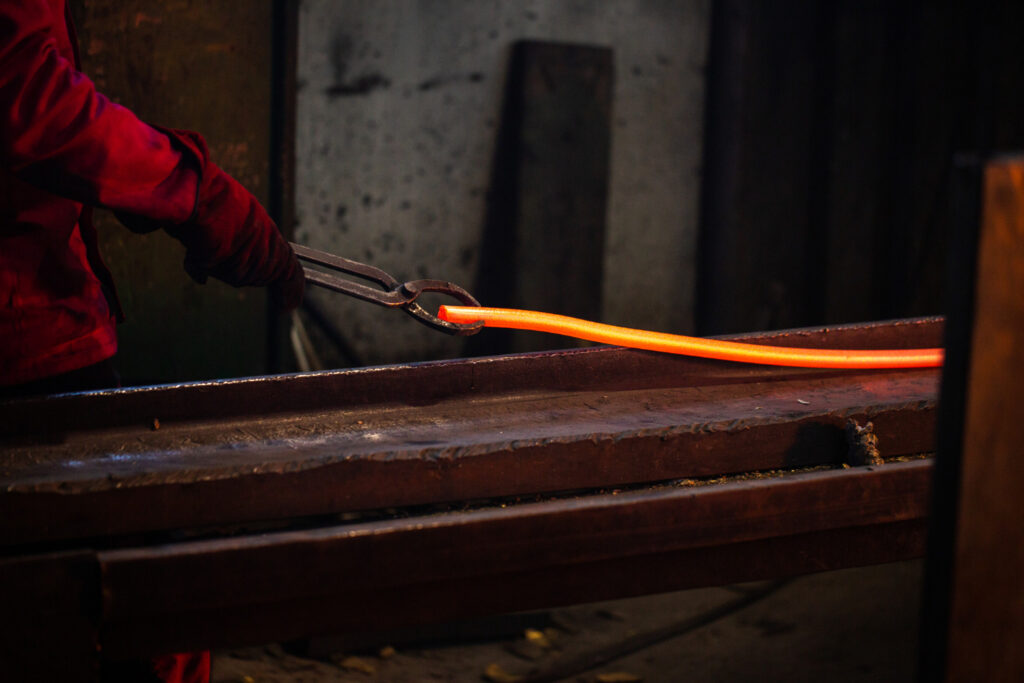
The heat treatments in steel These processes involve heating and cooling the material in a controlled manner to modify its physical and mechanical properties without losing its shape. Depending on the process, this can increase hardness, improve wear resistance, eliminate internal stress, or facilitate subsequent machining processes.
These processes are essential in sectors such as automotive, construction, industrial machinery, or any industry that uses metal parts with precise and uniform properties.
Temper
Tempering is one of the best known treatments and consists of heating the steel to a specific temperature and then rapidly cooling it, usually in water or oil. This process makes the material harder and more durable.
How tempering works
During heating, the crystalline structure of the steel changes, and when it cools rapidly, a structure known as martensite is produced, which is very hard but more brittle than untreated steel.
Applications of tempering
Hardening is often used on parts that require wear and fatigue resistance, such as gears, shafts, cutting tools, or components subjected to continuous mechanical stress. However, because hardening increases brittleness, it is often combined with other treatments such as annealing.
Tempering
Tempering is a post-hardening process that consists of reheat the steel to moderate temperatures and cool it slowlyThis process seeks to reduce the fragility generated by tempering and increase the toughness of the material, without losing too much hardness.
Benefits of tempering
Thanks to tempering, hardened steel gains balance between hardness and ductility, which allows the parts to withstand mechanical stress without breaking. This treatment is important for components that, in addition to resisting wear, must withstand impacts and deformations.
Common applications
Tempering is used on cutting tools, machine parts, automotive components, and any element subjected to combined stresses of tension and shock. Its precision ensures that each part meets the strength and safety requirements of the industrial project.
Annealing
Annealing is another of the most commonly used heat treatments for steel. Its main difference from tempering is that it does not aim to increase hardness, but rather soften the material, eliminate internal stresses and improve workability.
How annealing is performed
The steel is heated to a controlled temperature and held for a set time before being slowly cooled. This process causes the crystals in the steel to reorganize, reducing stresses built up during manufacturing processes such as cutting or welding.
Annealing applications
Annealing is best for preparing parts for later machining, as it improves ductility and facilitates cutting, bending, or stamping operations. It is also used for large parts that might deform if worked in the hardened or untreated state.
Advantages of heat treatments in steel
Implement heat treatments in steel It offers many benefits for the industry such as:
Increased durability: Treated parts are more resistant to wear and mechanical fatigue.
Controlled mechanical properties: Hardness, toughness and ductility can be adapted according to the function of each part.
Defect reduction: They eliminate internal tensions that could later cause future deformations or breakages.
Optimization of subsequent processes: They facilitate machining, welding and finishing, making production more efficient.
These benefits result in significant long-term economic savings and higher-quality products.
Heat treatments for steel are a key part of industrial manufacturing. Quenching, tempering, and annealing adapt the steel's properties to each need, ensuring stronger, more durable, and easier-to-work parts. Choosing the right treatment depends on the type of steel, the part's function, and the strength and durability requirements.
In Metal Transformed ToralWe combine experience in engineering, design, manufacturing, and assembly of industrial metal structures with extensive knowledge of heat treatments.
If you are looking for reliable solutions for your metal projects, do not hesitate to check out our service of design, manufacturing and assembly of industrial metal equipment. Visit our website and check out our services!


 English (UK)
  Español
  Français
  Deutsch