

Automation has completely transformed many sectors, including the way manufacturing companies work. In sectors where precision, repeatability, and efficiency are essential, robotization in industrial welding has become one of the most important technologies to increase competitiveness.
And it's not a passing trend: the incorporation of robots into welding processes represents an evolution toward much safer, faster, and higher-quality production. In this article, Metal Transformed Toral We tell you how it works, what benefits it brings and why its application is an advantage in the serial production.
What does robotization mean in industrial welding?
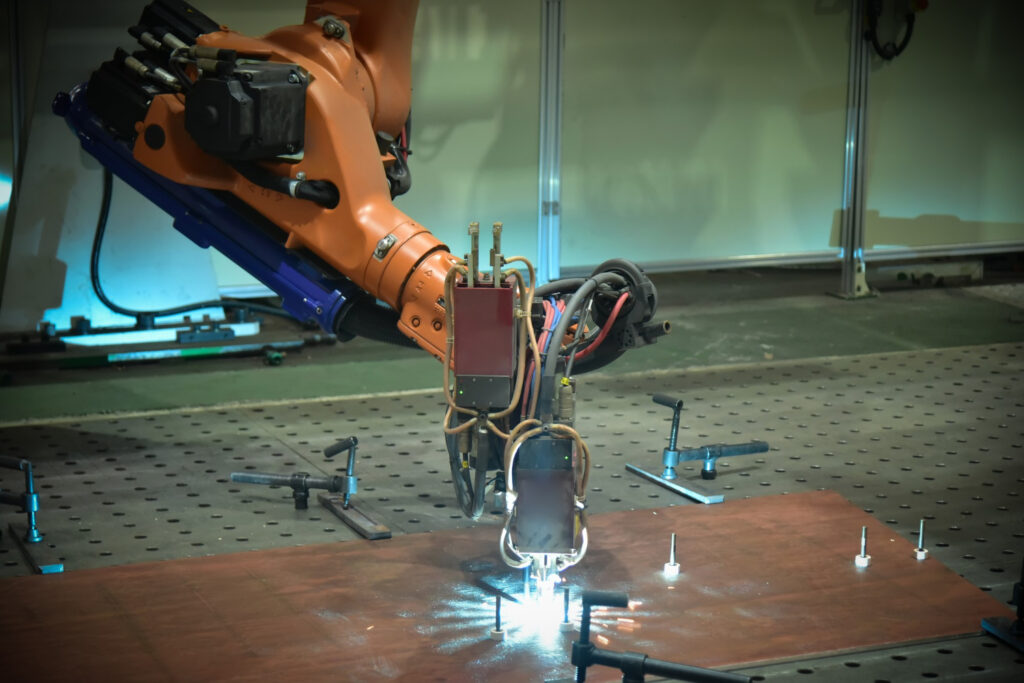
The robotization in industrial welding It consists of integrating robotic systems that perform welding tasks automatically, following precisely programmed parameters.
These robots are equipped with articulated arms and welding torches These systems replicate the movements of an operator, but with a much higher level of precision, speed, and repeatability. Currently, robotic welding is used in sectors such as the automotive, boilermaking, heavy machinery, and metal component manufacturing industries. In our case, for example, thanks to the use of these systems, production can be optimized while maintaining high standards of quality and safety.
Advantages of robotization in industrial welding
Using welding robots not only improves productivity; it also adds value to the quality of the final product and to working conditions. Here are the main ones. Advantages of robotization in industrial welding:
Constant precision and repeatability
One of the biggest benefits of robotization is the ability to maintain a uniform quality in every weld. Robots perform each action at the same speed, angle, and temperature, eliminating errors that a human can make, whether due to fatigue or lack of concentration.
In mass production, where every piece must be identical, this consistency is key to ensuring exact fits and perfect finishes.
Increased productivity
Robots can work in a continuous and without breaks, which multiplies the production rate. Furthermore, setup and changeover times between parts are much shorter thanks to programming and the use of automation.
Thanks to this, they are fulfilled tighter deadlines and increases responsiveness to large order volumes, which is essential in the modern metalworking industry.
Cost reduction
Although the initial investment in a robotic system may be a bit high, the return is rapid. Automation reduces labor costs, material waste and energy consumption, as robots optimize the exact amount of filler and welding speed. In the long term, robotization allows save resources and minimize rework, improving the overall profitability of the process.
Greater job security
Welding is one of the most demanding and dangerous industrial tasks. Heat, radiation, gases, and sparks are constant risks faced by workers.
With robotization, these tasks are done by the robot, which reduces human exposure to adverse conditionsThis way, workers can focus on other tasks such as supervision, quality control, and maintenance, which are ultimately safer and more specialized.
Flexibility in production
Modern robots are programmable and, thanks to this, they quickly adapt to different types of parts or welding processes (MIG/MAG, TIG, spot, arc, etc.).
This flexibility makes robotization a perfect solution not only for large repetitive series, but also for medium or custom productions where precision remains paramount.
Improved traceability and quality control
Every weld made by a robot can register and monitor yourself digitally, which facilitates the monitoring of production parameters and the detection of possible deviations.
This exhaustive control is essential for industries where the quality certification and structural reliability are essential, such as the manufacture of metal components or industrial structures.
Robotization and mass production: a special combination
In the serial productionExact repeatability is key. Every millimeter, every second, and every welding stroke counts.
The advantage of robotics is that it ensures that each manufactured unit is exactly the same as the previous one, with no differences in strength, geometry, or surface finish. reduces rejects, rework and downtime, achieving a continuous and efficient production flow.
Furthermore, by freeing workers from more repetitive tasks, companies can allocate their talent to higher-value processes, such as robot programming, method improvement, or quality inspection.
The future of industrial welding
Evolution continues and new systems incorporate artificial intelligence, computer vision, and adaptive sensors, capable of adjusting the process in real time according to material conditions or assembly tolerances.
These innovations will make robotic welding even more efficient, precise and sustainable, reducing energy consumption and waste generated.
The robotization in industrial welding It is a qualitative leap in the way of producing: faster, safer and with the same or better quality.
Its application in the serial production It allows you to maximize efficiency without sacrificing control or precision, essential factors for maintaining customer confidence and excellent results.
Are you looking for a company to mass produce products? In Metal Transformed ToralWe integrate robotic welding solutions as part of our commitment to innovation and continuous improvement. Visit our website and take a look at our services!


 English (UK)
  Español
  Français
  Deutsch