

When a client requests an industrial quote, one of the keys to a successful project from the outset is the quality of the technical information provided. In the metalworking industry, this is often largely contained in the technical specifications: a document that may seem complex, but is essential for defining scope, requirements, and execution criteria. Knowing how to read and interpret it correctly prevents errors, deviations, and inaccurate budgets.
Although often associated only with engineering firms, a good understanding of these specifications is also very useful for clients who want to make more precise requests and compare offers with sound judgment.
What is a technical specifications document?
It is the document that outlines the specifications that a manufacturing, installation, or supply project must meet. In the field of metalworking engineering, it may include materials, tolerances, finishes, treatments, tests, applicable regulations, assembly requirements, and acceptance criteria.
In other words, it defines what is expected of the project and under what criteria it should be executed.
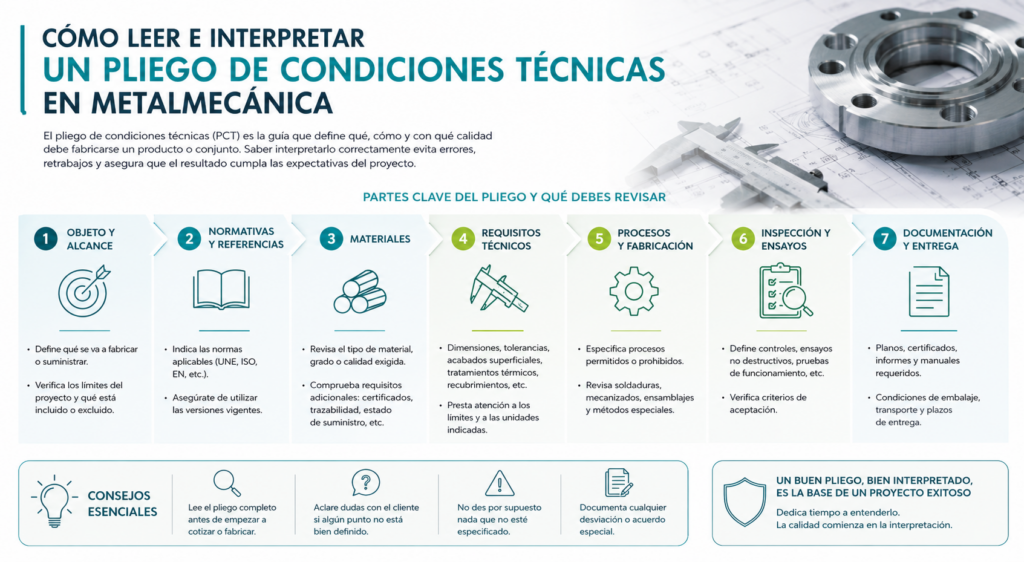
Why is it so important for an accurate budget?
If the specifications are clear and well-interpreted, the supplier can better assess resources, processes, deadlines, and risks. Conversely, if information is missing or certain requirements are misunderstood, the budget may fall short, be oversized, or lead to conflicts during execution.
A good analysis of the specifications helps to
- Identify critical requirements before bidding.
- Clarify technical doubts in a timely manner.
- Avoid ambiguities in materials or processes.
- Better adjust cost and timeframe.
Example of how to interpret a technical specification in metalworking
📄 TECHNICAL SPECIFICATIONS (Simplified Example)
1. Specified Material
Structural steel S275JR (UNE-EN 10025)
What should you check?
- That the material matches the one requested.
- If you require a quality certificate.
- If you require batch traceability.
¿Why is it important??
Using a different steel can affect mechanical strength, weldability, or even invalidate the project's certification.
2. Dimensions and tolerances
Thickness: 12 mm
Length: 2,000 mm
Tolerance: ±0.2 mm
What to check?
- The units (mm, cm or inches).
- The permitted tolerances.
- Critical dimensions for assembly.
⚠️ A part may have the correct dimensions and still be rejected for exceeding the stated tolerance.
3. Welding requirements
MIG/MAG Process
Required quality: ISO 5817 Level B
Check:
- Type of process allowed
- Welder qualification
- Welding Procedure Specification (WPS)
- Special laces
In many projects, it is not enough to weld correctly; it is also necessary to demonstrate that the specified procedure has been followed.
4. Surface treatment
Hot-dip galvanized
Minimum coating thickness:
85 μm
📌 Before manufacturing, check:
- Type of anti-corrosion protection.
- Required thickness.
- Prior surface preparation.
5. Quality controls
Required tests
- Dimensional inspection
- Visual control
- Penetrating liquids
- Final verification
📌 Not all projects require the same controls. The specifications define which tests are mandatory before accepting the part.
6. Required documentation
Deliver with the order:
- Certified EN 10204 3.1
- "As Built" Drawings«
- Dimensional report
- Declaration of conformity
Maintenance manual (if applicable)
A part may be perfectly manufactured and not be accepted if some of the required documentation is missing.
👉 Do you need to create a project from a plan or technical specification? Discover our services for project-based manufacturing and industrial engineering..
Common mistakes when interpreting a tender document
One of the most common mistakes is focusing solely on the plans and overlooking notes, appendices, or administrative conditions with technical implications. Another is failing to clarify contradictions before preparing a budget.
Failure also occurs when standard criteria are assumed where the specifications require something specific or more demanding.
How should a client approach this document?
Even if the supplier handles the technical review, the client benefits greatly from understanding at least the document's logic. The better the client defines their needs and requirements, the more comparable the offers will be, and the fewer surprises there will be later.
Therefore, even without being a specialist, it is advisable to carefully review the basic information and rely on a technical interlocutor when necessary.
Conclusion
Correctly interpreting a specification sheet is only the first step. The final quality will also depend on the manufacturing process, dimensional control, welding, and technical documentation being executed according to the project specifications. Companies specializing in engineering and metal fabrication They can contribute that knowledge from the initial phase to the final delivery.
The clearer the specifications and the better they are interpreted, the easier it will be to obtain a suitable, viable, and technically sound proposal.


 English (UK)
  Español
  Français
  Deutsch